
A - Anchor Community Power
DECENT SEAS · Tenth action
AAnchor Community Power
Social capital is the soil democracy grows in.
Everything else in this framework depends on something that has been quietly eroding for fifty years: the basic fact of knowing your neighbors, trusting the people around you, and having a web of relationships that can mobilize when something needs to happen. You can have the best policy arguments and the most strategic protest tactics, and if the social infrastructure underneath them is hollow, none of it sticks. Community power is not a soft add-on to civic action. It is the ground everything else is built on.
What we’ve lost
The loneliness epidemic is also a democracy emergency
In 2000, Harvard political scientist Robert Putnam published Bowling Alone — a landmark study of the decline of social capital in the United States. The title came from a specific observation: more Americans were bowling than ever, but bowling leagues were collapsing. People were doing the activity alone or in ad hoc groups rather than in the organized, recurring social structures that built relationships over time. The bowling was never the point. The point was the league — the regular gathering, the shared purpose, the people you knew well enough to ask for help.
Twenty-five years later, every metric Putnam tracked has gotten worse.
The state of American social connection — 2024–2025 data
16% of adults — including one in four adults under 30 — report feeling lonely or isolated all or most of the time, according to a 2024 Pew Research Center survey.
2 in 10 U.S. adults have no close friends outside of family. In 1990, only 3% said that.
Just under half of Americans belonged to a religious congregation in 2023 — the lowest point Gallup has recorded since it began tracking in 1937.
About half of Americans regularly spent time in a public community space in 2025 — a coffee shop, bar, restaurant, or park. That is down from about two-thirds in 2019.
Union membership stands at 10% — down from 20% four decades ago. Unions were not just labor organizations. They were one of the primary institutions through which working people built civic relationships and exercised collective power.
In 2023, the U.S. Surgeon General declared loneliness a public health epidemic — comparing its health risks to smoking and obesity. Isolation and loneliness are risk factors for cardiovascular disease, dementia, depression, and premature mortality. But loneliness is also a civic emergency. Communities where people don’t know each other, don’t trust each other, and don’t gather together are communities that cannot organize, cannot respond to crisis, and cannot hold power accountable.
“The bonds of trust and social networks serve as effective vectors for economic and political activity. In regions that lack networks of civic engagement, citizens have to resort to hierarchy and force to resolve conflict.” — Robert Putnam
2 in 10
U.S. adults with no close friends outside family — up from 3% in 1990
1 in 4
Adults under 30 who feel lonely or isolated all or most of the time
↓33%
Drop in Americans regularly spending time in public community spaces since 2019
What it actually means
Community power is not community spirit. It is organized capacity.
There is a difference between a neighborhood that feels warm and a neighborhood that can act. Community spirit is nice. Community power is what happens when enough people in a place know each other well enough, trust each other enough, and are organized enough to get things done together — to turn out for a school board meeting, to support a neighbor in crisis, to coordinate a response to a local threat, to run one of their own for office.
Researchers distinguish between two types of social capital. Bonding capital is the trust within close-knit groups — your family, your close friends, your immediate community. It provides solidarity and support. Bridging capital is the connections that span across differences — across neighborhoods, across demographics, across political identities. Bridging capital is what makes collective civic action possible at a scale beyond your immediate circle. Both matter. Bridging is what tends to be missing.
Mutual aid — the practice of neighbors meeting each other’s needs directly, outside of charity or government, on the basis of solidarity rather than hierarchy — is one of the most effective ways to build both types simultaneously. When you help your neighbor and your neighbor helps you, you are not just solving an immediate problem. You are building the relationship infrastructure that makes everything else possible.

What you can actually do
Start where you are. Small is how this works.
The mistake most people make when thinking about community power is assuming it requires a grand initiative. It doesn’t. It requires showing up, repeatedly, in ways that create and deepen real relationships. The following are not a hierarchy — they are options at different levels of investment. Start with whatever is available to you right now.
Know your neighbors by name
This sounds too simple to be political. It is not. Research on disaster response, community resilience, and civic engagement consistently finds that neighborhoods where people know each other’s names and have basic relationships are safer, more functional, and more able to mobilize collectively. Start with the people immediately around you. Introduce yourself. Learn their names. It compounds.
Join something that meets in person, regularly
The specific thing matters less than the regularity and the in-person nature. A neighborhood association. A book club. A faith community. A volunteer organization. A recreational league. A local Indivisible chapter. The recurring, face-to-face gathering is what builds the kind of trust and relationship that online groups cannot replicate. Pick something that fits your life and show up consistently.
Start or join a mutual aid network
Mutual aid is neighbors meeting needs directly — sharing food, tools, childcare, rides, skills, resources — without means-testing or bureaucracy. It is solidarity, not charity. Research from the pandemic period found that organizations using mutual aid as a community-building practice created stronger relationships, higher civic engagement, and greater collective capacity than those relying on traditional service models. Search for existing mutual aid networks in your area before starting a new one. mutualaid.org ↗
Create or use a neighborhood communication infrastructure
A group text, a Signal group, a community board, a neighborhood newsletter — any channel that gives the people in your immediate area a way to communicate quickly and directly is infrastructure. It enables coordination before a crisis rather than improvising during one. Nextdoor exists for this but has its own problems with surveillance and misinformation. A Signal group for your block or building is more private and more functional.
Host something
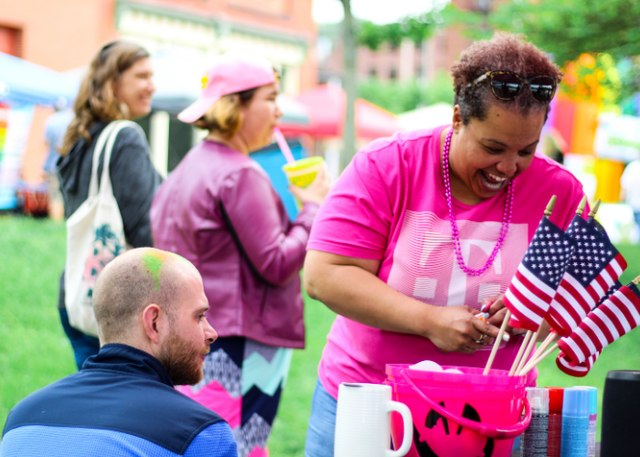
A potluck. A block party. A neighborhood cleanup. A community meeting. An informal gathering of people who share a concern. You do not need permission or a formal organization to do this. You need a date, a place, and an invitation. The DECENT SEAS framework asks you to show up in the streets and in the halls of power — but it also asks you to hold the table where people come together before and after those moments. That table matters.
Map your community’s assets and values-aligned businesses
Who in your community shares your values? Which local businesses, contractors, restaurants, and service providers are run by people who think like you do? Some local progressive community groups have already done this work — building informal directories of values-aligned businesses so that when you spend money locally, you know where it’s going. If that infrastructure doesn’t exist in your area, building it is one of the most practical things you can do. D — Dollars explains why this matters economically. A — Anchor is where the social infrastructure to do it gets built.
Build relationships across difference deliberately
Bonding capital — strong ties within your own community — is necessary but not sufficient. Bridging capital — relationships across neighborhoods, demographics, and political identity — is what creates the broader coalitions that make structural change possible. This is harder. It requires going to meetings where you are not the majority, joining organizations that serve communities different from yours, and showing up for issues that don’t affect you directly. It is also where the most durable power gets built.
The mutual aid distinction
Mutual aid is not charity. Charity flows from those who have to those who don’t, preserving the hierarchy between giver and receiver. Mutual aid is reciprocal — everyone both gives and receives, everyone participates in decisions, everyone’s needs matter equally. The distinction is not semantic. Research consistently finds that mutual aid organizations build more civic capacity, more durable relationships, and more political power than charitable service models. The goal is not just to meet immediate needs. It is to create the conditions for collective action.
How this connects
Community power is the infrastructure the whole framework runs on
Every other action in DECENT SEAS is more effective when it is taken from inside a strong community network. The call to your representative is more credible when you are calling with ten neighbors who all know each other. The local meeting is more powerful when you show up with people who trust each other. The mutual aid network becomes a political organizing network when crisis arrives. The values-aligned business directory becomes a community economic system when enough people use it together.
Isolation is not a personal failing. It is, as researchers have documented, a structural outcome of how American life has been organized over the past fifty years — toward individual consumption and away from collective participation. The deliberate rebuilding of community infrastructure is an act of resistance to that structure. It is also, as Robert Putnam spent his career arguing, the foundation without which democratic governance cannot function. Social capital is not a nice bonus. It is the soil democracy grows in.
This is true in Michigan and Manchester, in rural Kentucky and urban Sydney, in communities that have been economically abandoned and communities that have been gentrified beyond recognition. The specific forms differ. The need is universal. Wherever you are: find your people, build the table, and keep showing up.
This is what DECENT SEAS is built on — the understanding that decency is not a personal quality practiced in private. It is something you do with other people, in community, over time.
Common objections
What people say, and what’s actually true
Objection
“I don’t have time for community building on top of everything else.”
Reality
Community building is not an add-on to your life. It is a different way of doing things you are already doing — eating, gathering, helping, being helped. The potluck you host is also an organizing meeting. The mutual aid network you join is also a support system for you. The neighbor you know well is someone who can watch your kids when something comes up. These things compound and they return value. The question is not whether you have time. It is whether you can reframe time you are already spending.
Objection
“My neighbors don’t share my values. Building community here feels impossible.”
Reality
Shared values are not a prerequisite for shared community. You can know your neighbors, participate in local institutions, and build relationships with people who vote differently. That bridging capital is, in fact, exactly what is needed most. Communities with strong cross-difference relationships are more resilient and more able to navigate conflict without it becoming rupture. You do not have to agree on everything to be neighbors. The shared interest in a functioning community is often enough to start.
Objection
“This feels too soft. Real change happens through policy and power, not potlucks.”
Reality
Policy and power are built on organized people, and organized people require relationships. The most effective political organizing in American history — the labor movement, the civil rights movement, the LGBTQ+ rights movement — was built on deep community infrastructure: the church, the union hall, the bar, the neighborhood association. The potluck is not the destination. It is the infrastructure that makes everything else possible. Dismiss it and you are trying to build on sand.
Objection
“I moved recently / I’m introverted / I don’t know where to start.”
Reality
You start with one. One neighbor you introduce yourself to. One organization you attend once. One mutual aid network you join without committing to a role. One gathering you show up to. The research on community building does not suggest you need to be extroverted or have existing relationships. It suggests you need to begin. The relationships follow from showing up. The belonging follows from the relationships. Start smaller than you think you need to.
Quick reference
Where to go from here
Find local volunteer opportunities matched to your interests and availability. A practical entry point for meeting people through shared purpose.| Resource | Type | What it’s for |
|---|---|---|
| Mutual Aid Hub | Web | Directory of mutual aid networks across the U.S. and resources for starting one in your area. |
| Shareable | Org | Over 300 how-to guides on community sharing projects — food co-ops, tool libraries, repair cafes, time banks, and more. |
| Indivisible Group Finder | Org | Find a local Indivisible chapter — one of the most accessible entry points into organized community civic action. |
| VolunteerMatch | Web | |
| Bowling Alone — Robert Putnam | Book | The foundational study of social capital decline in America. Still the most comprehensive case for why community infrastructure matters. |
| Mutual Aid — Dean Spade | Book | A practical and political guide to mutual aid organizing. Short, accessible, and immediately actionable. |
A note on scope
This guide covers the social infrastructure underneath civic action. Joining organized political groups is covered under S — Sustain the Pressure. Moving your spending to values-aligned local businesses is covered under D — Dollars. Running for local office or organizing your workplace is covered under E — Elect and Empower Workers. This guide is about the relationships and trust that make all of those things more effective.
Previous action
← E — Economic Structures Must ChangeNext action
S — Shelter Is Non-Negotiable →DECENT SEAS guides are for informational purposes only and do not constitute legal, financial, medical, or professional advice. Organizations, platforms, businesses, and tools mentioned reflect our good-faith assessment at time of publication and are subject to change. DECENT SEAS has no financial relationship with any organization, brand, or business mentioned unless explicitly disclosed. Inclusion is not a guarantee or ongoing endorsement. We encourage you to verify, question, and use your own judgment. This content is provided as-is with no warranties expressed or implied.